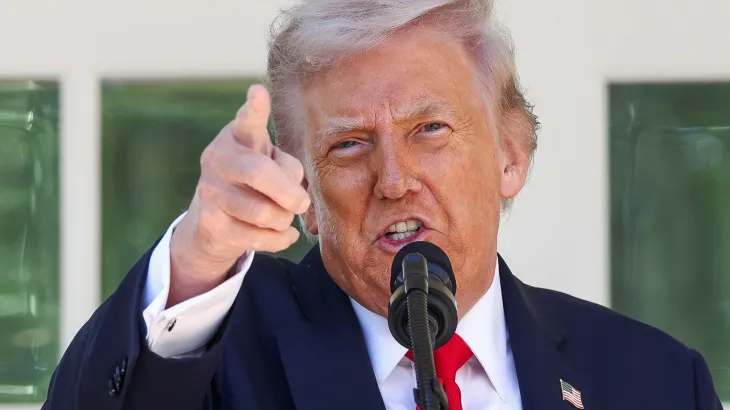
President Donald Trump on Thursday renewed his call for Senate Republicans to eliminate the filibuster, pressing the party to use what he described as the “Trump card” to end the month-long government shutdown. The demand marks a sharp escalation in his standoff with congressional Democrats as both sides remain deadlocked over budget negotiations.
The partial shutdown, now in its 30th day, began on October 1 after lawmakers failed to reach agreement on a federal funding package for the 2026 fiscal year. Trump argued that removing the Senate’s 60-vote threshold would allow Republicans to bypass Democratic opposition and swiftly pass a stopgap bill to reopen the government.
“It is time to get rid of the filibuster and end this destructive shutdown,” he said in a social-media post, framing the rule as an obstacle to governing.
Currently, Republicans hold a 53-47 majority in the Senate , short of the votes needed to advance most legislation without bipartisan support. Party leaders have so far resisted changing the rule, warning that scrapping the filibuster could backfire when control of the chamber shifts.
Economic Strain Grows as Political Tensions Deepen
The shutdown’s impact is spreading across the country, with roughly 750,000 federal employees furloughed or working without pay. Critical services such as food safety inspections, federal housing loans, and regulatory oversight have slowed or stopped altogether. Although the administration has ensured continued pay for military and law-enforcement personnel, many agencies remain paralyzed.
Economists estimate the standoff could trim between $7 billion and $14 billion from fourth-quarter growth, cutting as much as two percent from gross domestic product. Analysts warn that extended disruption could dampen consumer spending and slow recovery efforts in key sectors like travel, energy, and healthcare.
READ ALSO: Hamas Hands Over Two Bodies as Israeli Strikes Shatter Gaza Ceasefire
At the heart of the impasse lies disagreement over healthcare funding. Democrats have insisted that any temporary funding bill must include extensions of tax credits under the Affordable Care Act that help millions of Americans afford private coverage. Republicans, meanwhile, are pushing for a “clean” funding measure through November 21 without additional provisions.
Within the Senate, Trump’s proposal to invoke the “nuclear option” , a procedural move to eliminate the filibuster with a simple majority — has divided Republicans. A handful of allies, including conservative senators who have long criticized the rule, support the idea. However, several others have rejected it outright, describing the filibuster as a critical guardrail that preserves minority rights in Congress.
“The Senate was designed for deliberation, not domination,” one GOP senator said, underscoring the party’s reluctance to alter long-standing norms despite mounting pressure from the White House.
A Test of Power and Patience in Washington
As the shutdown drags into its second month, frustration is rising among federal workers and the broader public. Essential services remain uncertain, and local economies tied to government operations are showing signs of strain. With each passing day, the pressure intensifies for lawmakers to reach a compromise that reopens the government and stabilizes the economy.
Trump’s demand to end the filibuster signals his willingness to challenge congressional tradition in pursuit of a short-term win. Yet without unity among Senate Republicans and with Democrats holding firm , the path to resolution remains unclear.
The next few weeks are likely to determine not only the fate of the shutdown but also the balance of power within the Senate itself. For now, Washington remains locked in a political standoff that has left government workers unpaid, agencies idle, and the nation’s patience wearing thin.