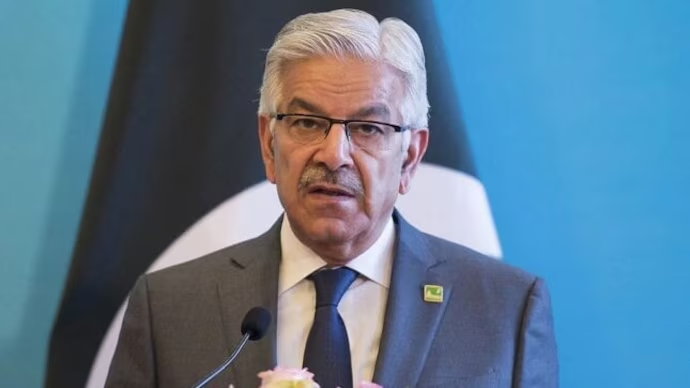
In a strongly worded statement, Pakistan’s Defence Minister Khawaja Muhammad Asif declared his country is “fully prepared” for a two-front war, citing potential conflict with India on its eastern border and with elements in Afghanistan on its western frontier. His remarks came on November 13 2025, a day after a suicide bombing in Islamabad that killed 12 and injured 36, claimed by the Tehrik‑e‑Taliban Pakistan (TTP). The minister claimed the attack was a “message from Kabul”, linking the Afghan Taliban and New Delhi in the ongoing regional tensions.
What the minister said and its implications
Asif asserted Pakistan is “ready for war on two fronts. We are ready, we are prepared to face both the eastern (India) and western border (Afghanistan). Allah helped us in round one and He will help us in round two”. He framed the Islamabad bombing as a provocation tied to the Kabul regime and labelled New Delhi as complicit in cross-border militancy directed at Pakistan. Meanwhile Indian officials dismissed the remarks as a “desperate attempt to deflect attention” amid mounting forensic indications that the car explosion near Delhi’s Red Fort involved military-grade explosives.
These declarations are noteworthy because they mark an escalation in Islamabad’s rhetoric, linking India and Afghanistan in a shared front of alleged aggression. Analysts see the remarks as reflecting Pakistan’s strategic posture amid diminishing diplomatic space and internal security pressures.
Regional context and reactions
Pakistan’s claims come against a backdrop of heightened India-Pakistan tensions and border incidents. Earlier this year Pakistan’s foreign minister had described India – Pakistan talks as “ready but not desperate”, while also stating the chances of renewed war were remote a contrast with the recent war-readiness rhetoric.
READ ALSO: Mali TikTok Star Publicly Executed as Jihadist Threats Deepen
On the western frontier, Pakistan accuses the Afghan Taliban of harbouring militants who attack Pakistan, with Kabul rejecting such claims and asserting its own security challenges. By implicating India in using Afghan territory as a proxy front, Pakistan is deepening the geopolitical web, linking its eastern and western security concerns.
For India, the threat of a two-front war though routinely cited remains a strategic concern given its commitments along the northern and western borders, and the possibility of diplomatic diversion or escalation.
Despite the tough talk, analysts caution that actual military confrontation on two fronts would impose severe logistical, economic and diplomatic costs for Islamabad, making the rhetoric possibly more about signalling than imminent action.